About 907 minutes
Etiquette — Edition Insights
Ethics
208,429 recorded words. 41 minutes difference from this book's estimate.
View Gutenberg source #14314
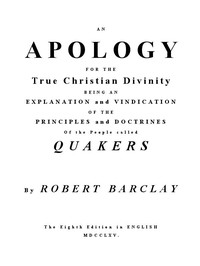
The catalog record for An Apology for the True Christian Divinity Being an explanation and vindication of the principles and doctrines of the people called Quakers — A Closer Reading provides practical reading context through 218,027 words, 15 hr 48 min estimated reading time, and 42 detected text sections.
The text analysis averages about 32.2 words per sentence, while the detected sections provide another way to judge how the source is divided.
Project Gutenberg metadata also associates the work with “Society of Friends -- Doctrines -- Early works to 1800,” connecting these edition facts with the source record’s subject description.
Explore this collection
These alternatives are selected using recorded categories and estimated reading time.
About 907 minutes
Ethics
208,429 recorded words. 41 minutes difference from this book's estimate.
View Gutenberg source #14314About 829 minutes
Ethics
190,598 recorded words. 119 minutes difference from this book's estimate.
View Gutenberg source #17147About 823 minutes
Ethics
189,100 recorded words. 125 minutes difference from this book's estimate.
View Gutenberg source #45041Search stored excerpts and compare books → Choose by your preferences →
Choices use stored catalog measurements. Estimates vary with reading speed. A shared category is a catalog label, not a claim that two books have the same argument or literary quality.
Search reads excerpt text stored with this catalog and links to its associated Gutenberg record. The connection is stored in the site database; this tool does not recheck that every excerpt is word-for-word identical to that external record. Excerpt search does not cover every chapter and does not verify historical publication dates.
Catalog snapshot checked: 2026-09-26. Coverage: 95 public books, 95 available source excerpts.
Calculated from edition completeness, EPUB availability, text structure and catalogue metadata. Not a user rating.
Total of 100 points, scaled to a 2.5-5.0 range. Editions with an empty description or a missing EPUB file are not scored.
Public-domain source text
The source text is kept in the dedicated reader, separate from this catalogue record and its commentary.
Robert Barclay's An Apology for the True Christian Divinity is organized as a sequence of fifteen propositions, each addressing a core doctrine of the early Quaker movement. The work opens with a dedicatory epistle to King Charles II, positioning the text as both a theological explanation and a public vindication. Barclay's method is forensic: he states a thesis, then defends it through scriptural exposition, patristic quotations, and responses to anticipated objections. The structure itself mirrors the Quaker emphasis on inward spiritual authority, as each proposition builds on the previous one, moving from the foundation of knowledge to the role of civil government.
The book's fifteen propositions form a logical chain. Proposition I establishes the true foundation of knowledge, while Proposition II argues for immediate revelation as the primary source of divine truth. Barclay then addresses the Scriptures (III), the condition of humanity in the Fall (IV), universal redemption (V–VI), justification (VII), and perfection (VIII). Later propositions cover perseverance (IX), ministry (X), worship (XI), baptism (XII), communion (XIII), civil magistracy (XIV), and outward practices like salutations (XV). Each proposition is subdivided into numbered sections, often including objections and replies. This systematic arrangement allows Barclay to contrast Quaker principles with what he calls the 'dark Night of Apostasy' that preceded the Restoration.
Throughout the excerpts, Barclay employs two dominant metaphors: 'Light' and 'Seed.' The Light is described as 'saving and spiritual,' given to every person for reproof and guidance. The Seed is the inward principle of grace that, when 'leavened into its Nature,' produces a holy life. Barclay distinguishes between the universal measure of grace (the Seed) and the full conversion that 'leavens' the soul. This organic imagery recurs in his discussion of ministry, where he insists that true ministers are those 'leavened by it into the Nature thereof.' The metaphors reinforce his central claim that salvation is an inward, transformative process rather than an external ritual.
Barclay's argumentative strategy involves frequent shifts between biblical citation and quotations from early church fathers. In the excerpts, he references Hebrews 5:4 to support the necessity of a divine call to ministry, and he cites Franciscus Lambertus on the role of the Holy Spirit in discerning Christ's voice. This movement is not merely decorative; Barclay uses patristic sources to show that Quaker doctrines align with primitive Christianity. His method anticipates objections by framing them as 'Objections' followed by 'Answers,' a scholastic structure that gives the text a courtroom-like rhythm. The result is a work that feels both ancient and immediate, grounded in a tradition of theological disputation.
Proposition XIV addresses the power of the civil magistrate in religious matters, a topic of acute relevance in Restoration England. Barclay argues for liberty of conscience, insisting that outward force cannot produce true faith. This section is notable for its careful delineation of spheres: the magistrate's authority is temporal, while the conscience is subject only to God. The argument is woven into the larger fabric of the Apology, as Barclay consistently prioritizes inward obedience over outward conformity. The dedicatory epistle to Charles II signals this concern from the outset, framing the entire work as an appeal for toleration based on theological principle rather than political expediency.
Readers approaching Barclay's Apology will benefit from attending to its propositional structure and the recurring imagery of light and seed. The work rewards careful reading of the objections and replies, where Barclay's dialectical skill is most evident. While the text is lengthy, its organization allows for selective study of individual propositions. The 1765 Baskerville edition reproduced here includes a table of contents and an index of authors cited, which can help navigate the dense argumentation.
That rainy afternoon, Barclay’s insistence on the inward light felt less like doctrine and more like a quiet hand resting on my shoulder. Later, idly tracing his scriptural footnotes, I stumbled toward a different question entirely—whether the historical man himself ever walked that ground. The shift was gentle, unforced, and soon I was lost in The Christ: A Critical Review and Analysis of the Evidences of His Existence — Key Ideas to Explore, the rain having softened to a whisper, the argument having changed shape entirely.
Capture what you thought, learned, and would like to remember.









