About 106 minutes
Fruits of Philosophy: A Treatise on the Population Question — Themes and Context
Ethics
24,240 recorded words. 6 minutes difference from this book's estimate.
View Gutenberg source #38185
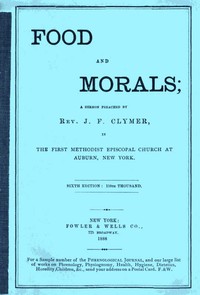
Food and Morals 6th Edition — Inside the Classic can be approached with a clearer sense of reading commitment from its source measurements: 22,865 words, 1 hr 40 min estimated reading time, and 17 detected text sections.
The text analysis averages about 20.0 words per sentence, while the detected sections provide another way to judge how the source is divided.
Project Gutenberg metadata also associates the work with “Food,” connecting these edition facts with the source record’s subject description.
Explore this collection
These alternatives are selected using recorded categories and estimated reading time.
About 106 minutes
Ethics
24,240 recorded words. 6 minutes difference from this book's estimate.
View Gutenberg source #38185About 106 minutes
Ethics
24,355 recorded words. 6 minutes difference from this book's estimate.
View Gutenberg source #69434About 93 minutes
Ethics
21,382 recorded words. 7 minutes difference from this book's estimate.
View Gutenberg source #14120Search stored excerpts and compare books → Choose by your preferences →
Choices use stored catalog measurements. Estimates vary with reading speed. A shared category is a catalog label, not a claim that two books have the same argument or literary quality.
Search reads excerpt text stored with this catalog and links to its associated Gutenberg record. The connection is stored in the site database; this tool does not recheck that every excerpt is word-for-word identical to that external record. Excerpt search does not cover every chapter and does not verify historical publication dates.
Catalog snapshot checked: 2026-09-26. Coverage: 95 public books, 95 available source excerpts.
Calculated from edition completeness, EPUB availability, text structure and catalogue metadata. Not a user rating.
Total of 100 points, scaled to a 2.5-5.0 range. Editions with an empty description or a missing EPUB file are not scored.
Public-domain source text
The source text is kept in the dedicated reader, separate from this catalogue record and its commentary.
Rev. J. F. Clymer’s 1880 sermon, published in its sixth edition by Fowler & Wells, opens with an unusual endorsement: a letter from Rev. Dr. Charles F. Deems recounting how he treated a young woman’s spiritual despair by prescribing for her torpid liver. This anecdote sets the tone for a work that moves between the pulpit and the pantry, arguing that moral health cannot be separated from physical digestion. The sermon’s structure alternates between scriptural exposition and detailed nutritional science, including a lengthy defense of the Health Food Company’s whole wheat flour against a competitor’s microscopic analysis.
The sermon’s opening frame is a correspondence between Deems and the publishers, who agree to issue Clymer’s discourse as part of “the gospel of hygiene.” Deems’s letter introduces a recurring motif: the body as a site of moral intervention. He describes a teenage girl “inconsolably laboring under the oppressive feeling that there was no mercy for her” and prescribes for her liver, not her soul. This episode establishes the work’s central claim—that spiritual states are materially conditioned—and foreshadows the movement between clinical observation and theological argument that defines the sermon’s structure.
A substantial portion of the excerpted text is devoted to a scientific controversy over flour analysis. Clymer cites Professor Albert N. Leeds’s chemical tests to refute Dr. Ephraim Cutter’s claim that the Health Food Company’s flour lacked gluten. The language shifts from homiletic to technical: “the microscope was valuable to detect adulterations, but valueless as a means of determining the percentages of the various natural constituents.” This detailed rebuttal, complete with percentages and brand names, illustrates how the sermon uses empirical evidence to bolster its moral framework. The body—and what enters it—becomes a subject for laboratory verification.
Throughout the excerpts, bodily and spiritual states are described in terms of blockage and release. Deems’s patient suffers from a “torpid liver”; the sermon later praises foods that are “bland, soluble, non-irritating.” The Health Food Company’s products are said to improve “blood-making processes” and “better digestion.” This imagery of obstruction and flow mirrors the sermon’s rhetorical movement: from a blocked spiritual condition (despair, sin) to a cleared physical one (proper nutrition, health). The structure itself enacts a kind of unblocking, moving from anecdote to analysis to prescription.
The text is not solely a religious address; it is also a promotional vehicle. The publisher’s preface and the extensive quotation of Professor Leeds’s analysis serve to endorse the Health Food Company’s products. Clymer’s sermon thus occupies a hybrid genre: part homily, part advertisement, part scientific report. The movement between these modes is abrupt—from “the grace of our Lord Jesus Christ” to “16.74 per cent. of this substance”—but consistent in its underlying argument: that moral improvement requires attention to material conditions. Readers should note how the sermon’s structure mirrors its content, joining the spiritual and the physical in a single, sometimes jarring, rhetorical form.
Readers approaching this sermon should attend to its shifts in register: from personal testimony to chemical analysis, from pastoral counsel to commercial endorsement. The work does not offer a systematic theology but rather a series of linked arguments that treat diet as a moral discipline. Its value lies less in doctrinal originality than in its concrete, period-specific fusion of religion and health reform.
I found myself thinking about that old sermon's odd certainty—that our aching bodies could somehow dictate our souls' condition. It reminded me, strangely, of another quiet volume that took the opposite path, exploring how despair might itself become a kind of steady ground. Thomas's liver complaint and the despair's patient arguments both feel like relics of a slower time. The Philosophy of Despair — Themes and Context lingers with me the same way—neither comforting nor alarming, just true.
Create a short personal record of your experience with this book.









