About 248 minutes
The Abominations of Modern Society — Context and Discussion
Ethics
56,958 recorded words. 1 minutes difference from this book's estimate.
View Gutenberg source #13104
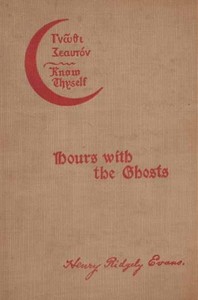
Before opening Hours with the Ghosts or, Nineteenth Century Witchcraft Illustrated Investigations into the Phenomena of Spiritualism and Theosophy — Reading Notes, the edition data offers a quick orientation: 56,718 words, 4 hr 7 min estimated reading time, and 6 detected text sections.
The text analysis averages about 19.5 words per sentence, while the detected sections provide another way to judge how the source is divided.
Project Gutenberg metadata also associates the work with “Spiritualism,” connecting these edition facts with the source record’s subject description.
Explore this collection
These alternatives are selected using recorded categories and estimated reading time.
About 248 minutes
Ethics
56,958 recorded words. 1 minutes difference from this book's estimate.
View Gutenberg source #13104About 243 minutes
Ethics
55,800 recorded words. 4 minutes difference from this book's estimate.
View Gutenberg source #16538About 259 minutes
Ethics
59,404 recorded words. 12 minutes difference from this book's estimate.
View Gutenberg source #65545Search stored excerpts and compare books → Choose by your preferences →
Choices use stored catalog measurements. Estimates vary with reading speed. A shared category is a catalog label, not a claim that two books have the same argument or literary quality.
Search reads excerpt text stored with this catalog and links to its associated Gutenberg record. The connection is stored in the site database; this tool does not recheck that every excerpt is word-for-word identical to that external record. Excerpt search does not cover every chapter and does not verify historical publication dates.
Catalog snapshot checked: 2026-09-26. Coverage: 95 public books, 95 available source excerpts.
Calculated from edition completeness, EPUB availability, text structure and catalogue metadata. Not a user rating.
Total of 100 points, scaled to a 2.5-5.0 range. Editions with an empty description or a missing EPUB file are not scored.
Public-domain source text
The source text is kept in the dedicated reader, separate from this catalogue record and its commentary.
Henry Ridgely Evans opens Hours with the Ghosts with a frontispiece captioned “Spirit Photograph. [Taken by the Author.],” immediately signaling his dual role as investigator and documentarian. The book’s subtitle, “Nineteenth Century Witchcraft,” frames spiritualism and theosophy as modern superstitions worthy of scientific scrutiny. Evans draws on the Seybert Commission’s investigation of Pierre Keeler, reproducing verbatim a handbill that promises “Spirit Materializations, Marvelous Superhuman Visions, Spiritualistic Rappings, Slate Writing, Spirit Pictures, Floating Tables and Chairs.” The handbill’s language—addressing “the Clergy, the Press, Learned Synods and Councils”—reveals how mediums marketed their performances to a credulous public.
Evans includes the full text of Pierre Keeler’s promotional handbill, a document that reads like a carnival barker’s pitch. It promises “a NIGHT OF Wonderful Manifestations” and claims that “the whole world have proclaimed these Philosophical Idealisms to be an astounding FACT.” The handbill explicitly invites skepticism: “Do not class or confound SLADE with the numerous so-called spirit mediums and spiritual exposers that travel through the country, like a set of roaming vampires.” This self-conscious distinction between genuine and fraudulent mediums is a recurring rhetorical strategy. Evans lets the handbill speak for itself, allowing readers to see how mediums framed their own credibility.
The Seybert Commission, appointed by the University of Pennsylvania, included prominent scientists and physicians: Dr. William Pepper, Dr. Joseph Leidy, Dr. Horace H. Furness, and Dr. S. Weir Mitchell. Evans reproduces their report verbatim, describing a séance at Mr. Furness’s house on May 27. The medium, Pierre Keeler, is described as “a young man, with well cut features, curly brown hair, a small sandy mustache.” The commission’s dry, observational tone contrasts sharply with Keeler’s flamboyant advertising. Evans does not editorialize; he simply juxtaposes the handbill’s promises with the commission’s clinical account, letting the discrepancy emerge naturally.
Evans devotes a chapter to “Psychography or Slate-writing,” a phenomenon in which messages supposedly appeared on slates held by mediums. He includes illustrations of slates with writing, numbered as figures 4, 5, and 6. The text does not reveal how the tricks were performed, but the very act of illustrating the slates implies that the writing was physically present. Evans’s approach is to present evidence—handbills, commission reports, photographs—and let readers draw conclusions. The book’s structure, moving from subjective phenomena like telepathy to physical phenomena like materializations, mirrors the investigative logic of the Society for Psychical Research, whose members Evans quotes in his epigraphs.
Evans’s book is less a polemic than a curated archive of spiritualist ephemera. Readers should attend to the documents he reproduces—handbills, commission reports, and medium advertisements—rather than seeking a unified argument. The value lies in the raw material: the language of the mediums, the skepticism of the scientists, and the unresolved tension between belief and exposure. Evans himself remains an ambiguous figure, both photographer of spirits and chronicler of fraud.
That rainy Tuesday, I sat with Evans’ dismantled séances, feeling oddly fond of the ghosts he debunked—their yearning was so human. My hand drifted, almost by accident, to a shelf holding Keep Happy — Text and Context, and I found the same quiet ache there, only turned toward sunlight.
Use these questions to collect your thoughts before moving on.









