
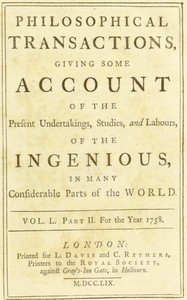
Philosophical transactions, Vol. L. Part II. For the year 1758. by Various et al.
Forget everything you know about modern, specialized science journals. Philosophical Transactions, Vol. L. Part II for 1758 is a sprawling, eclectic record of curiosity. There's no single plot. Instead, imagine a year's worth of letters from the frontiers of knowledge, all mailed to the Royal Society of London. One contributor is tracking a comet's path across the sky. Another is meticulously recording the effects of a total solar eclipse. Someone else is trying to manufacture cold in a lab, while a correspondent from the colonies is sending back observations of American plants.
The Story
The 'story' here is the progress of understanding itself. The standout thread involves a paper by John Bird, which provided the precise astronomical observations that allowed the German astronomer Johann Palitzsch to recover Halley's Comet that same year—confirming Edmond Halley's prediction from decades earlier. This was huge. It proved that celestial bodies could be predicted mathematically. Woven around this are other narratives: accounts of strange weather, medical case studies, descriptions of new technologies like improved navigational instruments, and geological surveys. It's a mosaic of inquiry, where astronomy, physics, medicine, and natural history sit side-by-side as parts of one giant puzzle.
Why You Should Read It
Reading this isn't about learning outdated facts. It's about feeling the texture of discovery. You get the excitement of being right on the cusp—like in the comet paper, where prediction meets observation. But you also get the wonderfully odd detours, like an essay on the properties of 'mephitic air' (what we call carbon dioxide). The authors write with a directness and earnestness that's refreshing. They're showing their work, asking for feedback, and building a shared base of knowledge. It makes you appreciate how science is a human endeavor, full of collaboration, chance, and stubborn dedication.
Final Verdict
This is perfect for anyone who loves history, science, or just great human stories. If you enjoyed books like The Age of Wonder or are fascinated by how ideas change, you'll find this original source material utterly captivating. It's not a light read—some passages are technical—but you can dip in and out. Think of it as the most intellectual time machine you'll ever open. You come away with a deep respect for those 18th-century minds who, with simpler tools but immense patience, began mapping the contours of our modern world.
This digital edition is based on a public domain text. Distribute this work to help spread literacy.
Donna Ramirez
1 year agoFrom the very first page, the storytelling feels authentic and emotionally grounded. Exactly what I needed.
Richard Scott
1 year agoAmazing book.
Daniel Flores
1 year agoI didn't expect much, but the pacing is just right, keeping you engaged. I couldn't put it down.
William Williams
1 year agoThe index links actually work, which is rare!



James Johnson
8 months agoThe clarity of the concluding remarks is very professional.