About 35 minutes
The Economic Functions of Vice — A Reader’s Guide
Ethics
7,982 recorded words. 4 minutes difference from this book's estimate.
View Gutenberg source #31768
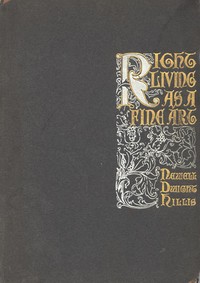
For Right Living as a Fine Art A Study of Channing's Symphony as an Outline of the Ideal Life and Character — A Closer Reading, the stored edition analysis reports 8,852 words, 39 min estimated reading time, and 1 detected text section.
The text analysis averages about 20.6 words per sentence, while the detected sections provide another way to judge how the source is divided.
Project Gutenberg metadata also associates the work with “Conduct of life,” connecting these edition facts with the source record’s subject description.
Explore this collection
These alternatives are selected using recorded categories and estimated reading time.
About 35 minutes
Ethics
7,982 recorded words. 4 minutes difference from this book's estimate.
View Gutenberg source #31768About 44 minutes
Ethics
9,977 recorded words. 5 minutes difference from this book's estimate.
View Gutenberg source #4754About 48 minutes
Ethics
11,028 recorded words. 9 minutes difference from this book's estimate.
View Gutenberg source #29881Search stored excerpts and compare books → Choose by your preferences →
Choices use stored catalog measurements. Estimates vary with reading speed. A shared category is a catalog label, not a claim that two books have the same argument or literary quality.
Search reads excerpt text stored with this catalog and links to its associated Gutenberg record. The connection is stored in the site database; this tool does not recheck that every excerpt is word-for-word identical to that external record. Excerpt search does not cover every chapter and does not verify historical publication dates.
Catalog snapshot checked: 2026-09-26. Coverage: 95 public books, 95 available source excerpts.
Calculated from edition completeness, EPUB availability, text structure and catalogue metadata. Not a user rating.
Total of 100 points, scaled to a 2.5-5.0 range. Editions with an empty description or a missing EPUB file are not scored.
Public-domain source text
The source text is kept in the dedicated reader, separate from this catalogue record and its commentary.
Newell Dwight Hillis opens Right Living as a Fine Art by placing Channing's 'Symphony' within a sweeping historical narrative: the revival of learning, religion, liberty, and now beauty. He argues that utility alone no longer suffices—craftsmen must become artists, and even hymns must be beautiful. This framing immediately establishes the book's central metaphor: right living as an aesthetic pursuit, not merely an ethical one.
The excerpts show Hillis building his argument through contrasts and concrete examples. He compares the brief art epochs of Phidias and Raphael to a 'vestal virgin' fanning a flame, then shifts to modern manufacturing's struggle for grace and color. These opening pages set a pattern of pairing historical reference with practical illustration, inviting the reader to see character as something to be shaped with the same care as a statue or painting.
The book's first chapter uses Channing's poem as a structural outline, but Hillis does not simply annotate it. Instead, he treats the 'Symphony' as a distillation of ideals that the rest of the volume will expand. The opening pages move from broad cultural history to the individual's task: 'to let the spiritual, unbidden and unconscious, grow up through the common.' This phrase from Channing becomes a recurring touchstone.
Hillis's method is cumulative. He introduces the idea of beauty as a commodity, then narrows to the personal realm. The reader should note how each subsequent chapter—on wealth, wisdom, inferiority, and perfection—returns to this core tension between the useful and the beautiful. The excerpts suggest that Hillis views character not as a fixed state but as a dynamic work in progress, akin to an artist refining a composition.
In the chapter 'The Disguises of Inferiority,' Hillis unpacks four maxims from Channing: 'Act frankly, talk gently, await occasions, hurry never.' He treats these not as platitudes but as principles with psychological and practical weight. For example, he contrasts 'the iron hand in a velvet glove' with the openness of 'glass bee-hives,' arguing that great men have no need for concealment because they possess 'enormous reserves.'
The discussion of gentleness is particularly vivid. Hillis asserts that 'noise is weakness' and 'bluster is inferiority rising into consciousness.' He illustrates with natural metaphors: planets move noiselessly, dewdrops crystallize with immense energy, and 'monarch energies work silently in the roots and harvests.' The reader is encouraged to see these maxims as interconnected—frankness enables gentleness, and both require the patience to await occasions.
Hillis devotes a section to 'await occasions,' framing timeliness as the essence of good work. He uses the astronomer who sails to Africa and waits weeks for an eclipse, and the husbandman who waits for the right season. Nature, he writes, 'will not be hurried.' This emphasis on patience counterbalances the earlier call to action, suggesting that right living involves knowing when not to act.
The excerpts show Hillis extending this idea to intellectual and spiritual life. He describes hours of reverie when the soul marvels at having been 'tossed about upon these furious currents of ambition.' Fame, ambition, and success all whisper that joy is not in them. The youth who learns solitude finds a happiness 'that the world can neither give nor take away.' This section thus connects the maxim 'hurry never' to a deeper practice of stillness and reflection.
The later chapters, as indicated by the table of contents, move toward synthesis: 'Strength Blossoming into Beauty' and 'Life's Crowning Perfection.' While the excerpts do not include these sections, the pattern established earlier suggests that Hillis will argue for the integration of force and grace. The opening claim that 'the artisan must become an artist' finds its personal counterpart here: character must combine strength with refinement.
Readers should watch for how Hillis returns to the metaphor of art. The 'Symphony' itself is a musical form, and the book's structure may mirror that—each chapter a movement building toward a harmonious whole. The closing quotation from Psalm 90:17, 'let the beauty of the Lord our God be upon us,' reinforces the idea that beauty is not merely aesthetic but divine. The editorial note cannot confirm the content of these final chapters, but the trajectory is clear: right living is a fine art because it transforms raw strength into something both useful and beautiful.
This edition presents Hillis's work as a continuous argument, but readers may benefit from pausing after each chapter to consider how its specific illustrations—the glass beehive, the noiseless planet, the waiting astronomer—relate to Channing's original lines. The book rewards attention to its recurring contrasts: noise versus silence, concealment versus frankness, haste versus patience. By tracing these threads, a first reading can move beyond abstract advice to see the concrete texture of Hillis's ideal.
I’ve often thought that Hillis’s careful notes on Channing’s Symphony hold the same patient, quiet breath as an old friend’s letter. That urge to wait for occasions, to let frankness soften into gentleness, finds its echo in the steadier meditations of Life and Conduct — Background and Themes, as if both volumes were shelved side by side, sharing a single, unhurried sigh.
Capture what you thought, learned, and would like to remember.









