About 823 minutes
Mental Philosophy: Including the Intellect, Sensibilities, and Will — Background and Themes
Ethics
189,100 recorded words. 46 minutes difference from this book's estimate.
View Gutenberg source #45041
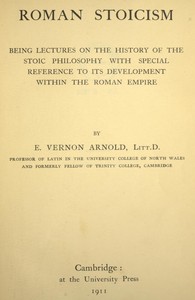
For Roman Stoicism being lectures on the history of the Stoic philosophy with special reference to its development within the Roman Empire — Themes and Context, the stored edition analysis reports 178,650 words, 12 hr 57 min estimated reading time, and 42 detected text sections.
The text analysis averages about 15.3 words per sentence, while the detected sections provide another way to judge how the source is divided.
Project Gutenberg metadata also associates the work with “Stoics,” connecting these edition facts with the source record’s subject description.
Explore this collection
These alternatives are selected using recorded categories and estimated reading time.
About 823 minutes
Ethics
189,100 recorded words. 46 minutes difference from this book's estimate.
View Gutenberg source #45041About 829 minutes
Ethics
190,598 recorded words. 52 minutes difference from this book's estimate.
View Gutenberg source #17147About 690 minutes
Ethics
158,541 recorded words. 87 minutes difference from this book's estimate.
View Gutenberg source #66508Search stored excerpts and compare books → Choose by your preferences →
Choices use stored catalog measurements. Estimates vary with reading speed. A shared category is a catalog label, not a claim that two books have the same argument or literary quality.
Search reads excerpt text stored with this catalog and links to its associated Gutenberg record. The connection is stored in the site database; this tool does not recheck that every excerpt is word-for-word identical to that external record. Excerpt search does not cover every chapter and does not verify historical publication dates.
Catalog snapshot checked: 2026-09-26. Coverage: 95 public books, 95 available source excerpts.
Calculated from edition completeness, EPUB availability, text structure and catalogue metadata. Not a user rating.
Total of 100 points, scaled to a 2.5-5.0 range. Editions with an empty description or a missing EPUB file are not scored.
Public-domain source text
The source text is kept in the dedicated reader, separate from this catalogue record and its commentary.
Arnold opens his lectures by situating Stoicism as a philosophical bridge, arguing that earlier treatments, such as Zeller's, undervalued the system by treating it as a mere sequel to Plato and Aristotle. He aligns with scholars like Stein and von Arnim who assign Stoicism a higher rank. The preface reveals a deliberate structure: the book emerged from lectures for Latin Honours students at the University of Wales, yet aims for a wider audience. Arnold's voice is measured and scholarly, frequently citing Greek terms in parentheses—a habit that persists throughout the excerpts. He acknowledges debts to Pearson and Caldecott, and notes the importance of von Arnim's 'Stoicorum veterum fragmenta' for Greek source material. This framing establishes the work as both a pedagogical tool and a contribution to ongoing scholarly conversation.
Arnold devotes sustained attention to the concept of the principate (ἡγεμονικόν), the soul's governing part. He describes it as both one and many-named, echoing the deity's nature. In the excerpts, he lists its titles: reason, intellect, will, the 'ego,' the divinity within. He draws on Marcus Aurelius, who calls it the Pilot, King, Lawgiver, Controller, and God within. Arnold emphasizes that although reason and will can be distinguished for discussion, they are intermingled in practice. The principate as reason includes perception, assent, comprehension, and the power to form a consistent system. Yet assent is also an act of will, and judgments lead to action. Arnold insists that the reasoning power must be kept pure to control the soul's inclinations. This dual aspect—reason and will—is central to his analysis, and he supports it with a dense network of citations from Stoic sources.
Arnold explains the right condition of the principate as will through a series of analogies drawn from different philosophical domains. From physics, it is a proper strain or tension, opposed to slackness. In theology, it is the agreement of the particular will with the divine will. From the will itself, it is strength and force, the attitude that makes a man say 'I can.' He compares it to health in the body, and in a quiet mood, to a restful and calm condition. Finally, he likens the soul to a State: the principate at its best is a just and kind sovereign, but if misdirected, it becomes a greedy tyrant. These analogies are not merely illustrative; they reflect the Stoic method of integrating physics, theology, and ethics. Arnold's prose here is methodical, each analogy introduced with 'Thus' or 'Again,' building a cumulative picture of the will's ideal state.
Arnold addresses the principate's divine origin and its eventual re-absorption in the deity. He quotes the paradoxical statement 'You are a god,' and notes that proof lies in man's interest in things divine. This divine aspect provides the first incentive to lofty morality. However, Arnold is careful to mark the point where human and divine part company: when considering the seven distinctly human manifestations of the soul, or its possible degradation from health and virtue. The deity is not conceived in human form and is not subject to human weaknesses. This distinction prevents over-identification of the human with the divine. Arnold's treatment is precise, using the excerpts to show how Stoic theory maintains a boundary even while asserting kinship. The language is academic but clear, with Greek terms parenthetically supplied to anchor the discussion in original sources.
Arnold's lectures reward readers who attend to his use of Greek terminology and his layered analogies. The excerpts show a writer who builds arguments through accumulation of sources rather than linear narrative. Readers may find it helpful to track the recurring term principate across chapters, as it serves as a conceptual anchor. The book's origin as lectures explains its periodic summaries and signposting; these can be used to navigate the dense philosophical material. Arnold assumes familiarity with classical philosophy, but his careful definitions make the work accessible to determined newcomers.
Arnold’s lectures, tracing the principate’s quiet rule over the soul, left me thinking about that Roman balance of reason and will—how it lingers in our own minds. The old distinction between intellect and feeling reminds me of a well-thumbed copy of Mental Philosophy: Including the Intellect, Sensibilities, and Will — Background and Themes, which once sat beside my father’s chair. There’s something tender in that shared permanence.
Use these questions to collect your thoughts before moving on.









