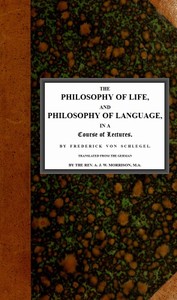
The philosophy of life, and philosophy of language, in a course of lectures
The Story
Don't expect a novel here. This is more like sitting in on a series of laid-back, fascinating lectures given by a philosopher who sees deep connections between why we’re alive and why we bother talking about it. Friedrich Schlegel argues that life’s big questions—what’s important meaning, who we are—aren't separate from the words we pick. He thinks language actually shapes our reality. If we talk about everything through a filter of cold logic, we miss out on the poetry of being alive. If we use vague words, we lose touch with concrete meaning. The storyline is this: our whole civilization drifted when we lost the balance between poetic feeling and philosophical clarity.
Why You Should Read It
Honestly, this book strips away a lot of the mystery around why modern life feels so fractured. We constantly argue online, talk past each other, and feel disconnected from any deep sense of purpose. Schlegel got there first. He’s basically saying that our junk language gives us junk meaning. When your only words for important stuff is just reaction or vibe, how do you even talk about love, justice, God, or hope? That stressed-out feeling you get from social media debates? This book traces back to that disconnect between what you feel inside and the stale words we’re handed. So the chapter on Romantic poetry and sober science became my personal favorite—he made me see that genuine life meaning requires us to rediscover a richer way to talk that includes both feeling and thought. It made even me want to pause, reread a favorite sentence from a poem, or just enjoy nature without glitching through my phone.
Final Verdict
This book isn't for someone looking for a breezy summer read. It's for the curious reader who sometimes stares out a window and wonders if the life we live and the words we use are just skimming the surface. If you enjoy authors like Carl Jung (about life meaning) or contemporary linguistic thinkers but you want the original storyline, this fits. It’s also great if you love European thought and the wild idea that your personal clarity shapes everything around you. A heads up though: these are written lectures, so there’s some rambling. Chapters vary in density; skip the super technical language theory and revisit the sections on life’s soul and your own inner poet. In that case, it’s as satisfying as discovering the root of a long-unspooled thread that finally makes sense of your everyday confusion.
This is a copyright-free edition. It serves as a testament to our shared literary heritage.
Christopher Martin
10 months agoFrom a researcher's perspective, the evidence-based approach makes it a very credible source of information. It’s hard to find this much value in a single source these days.