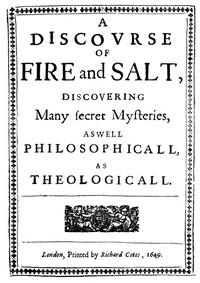
A Discovrse of Fire and Salt Discovering Many Secret Mysteries as well Philosophicall, as Theologicall — Text and Context

(0 User reviews)   554
In Category - Logic
Vigenère, Blaise de, 1523-1596, Stephens, Edward, active 1649 [Translator] Project Gutenberg 2014 Not confirmed
Alchemy -- Early works to 1800; Fire -- Early works to 1800; Salt -- Early works to 1800 Readers of public-domain and historical texts
Project Gutenberg digital edition en

Edition facts

Words 72,972
Reading time 318 min
Text sections 8

This digital edition of A Discovrse of Fire and Salt Discovering Many Secret Mysteries as well Philosophicall, as Theologicall — Text and Context is described by source-level measurements including 72,972 words, 5 hr 18 min estimated reading time, and 8 detected text sections.

The text analysis averages about 39.8 words per sentence, while the detected sections provide another way to judge how the source is divided.

Project Gutenberg metadata also associates the work with “Alchemy -- Early works to 1800,” connecting these edition facts with the source record’s subject description.

Explore this collection

Compare your next read

These alternatives are selected using recorded categories and estimated reading time.

Search stored excerpts and compare books → Choose by your preferences →

How these choices and excerpts are prepared

Choices use stored catalog measurements. Estimates vary with reading speed. A shared category is a catalog label, not a claim that two books have the same argument or literary quality.

Search reads excerpt text stored with this catalog and links to its associated Gutenberg record. The connection is stored in the site database; this tool does not recheck that every excerpt is word-for-word identical to that external record. Excerpt search does not cover every chapter and does not verify historical publication dates.

Catalog snapshot checked: 2026-09-26. Coverage: 95 public books, 95 available source excerpts.

Edward Stephens's 1649 translation of Blaise de Vigenère's alchemical treatise intertwines scriptural exegesis with practical laboratory procedures, using fire and salt as dual keys to unlock both natural philosophy and theological mysteries.
Share
Editorial Edition Score 4.7/5

Calculated from edition completeness, EPUB availability, text structure and catalogue metadata. Not a user rating.

How this score is calculated
  • Description quality20 pts
  • Title & short description10 pts
  • Source metadata20 pts
  • Text length15 pts
  • Chapters / structure15 pts
  • EPUB file integrity20 pts

Total of 100 points, scaled to a 2.5-5.0 range. Editions with an empty description or a missing EPUB file are not scored.

Edition quality

Read the Text

hat shee forsooke the _Rhodians_, for that they sacrificed unto her without fire, to goe to the _Athenians_. Moreover _Vulcan_, according to _Diadorus_, was a man, _who from an accident by a clap of Lightning, whereby a Tree was set on fire, first revealed to the Ægyptians the commodity and use of Fire: for being therewithall overcome, all joyfull of his light and heate; he thereunto added other matter to keepe it, whilest hee went to seeke the people, who afterward for this, deified him_. Whereto _Lucretius_ agrees,

_Do not in these things tacitely and by chance require, Lightning brought fire on earth to mortalls First: thence all heate of flame was given_.

[Sidenote: 1500 years.]

Edward Stephens's 1649 translation of Blaise de Vigenère's treatise opens with a striking fusion of biblical commentary and alchemical inquiry. The dedicatory epistle to Captain Thomas Falconbridge frames the work as a foreign-born text 'swadled up in an English habit,' immediately signaling the translator's awareness of cultural and linguistic mediation. The treatise itself begins not with a laboratory recipe but with Pythagoras, whom Vigenère presents as a pagan philosopher who 'quaffed full draughts from the living source of Mosaicall Traditions.' This move establishes a hermeneutic pattern: the author reads ancient authorities—whether Greek, Egyptian, or Hebrew—as precursors to Christian truth, and he treats fire and salt as substances that operate simultaneously in the physical and spiritual realms.

Scriptural Anchoring and Allegorical Method

Vigenère grounds his entire project in Mark 9:49: 'Every man shall be salted with Fire, and every Sacrifice shall be salted with Salt.' He then expands this verse into a fourfold scheme—Man, Sacrifice, Fire, Salt—which he promptly reduces to two pairs, emphasizing 'the conformitie they beare each to other.' This reduction is typical of his method: he treats biblical text as a dense network of correspondences that can be unpacked through allegory. He cites Origen's homily on the Song of Songs, where gold signifies 'the invisible and incorporeall nature' and silver 'the vertue of the Verb.' Such exegesis is not decorative; it provides the interpretive framework for the alchemical operations that follow. The reader is repeatedly reminded that the same substances that appear in the laboratory also appear in scripture, and that understanding one requires understanding the other.

Practical Procedures and Reserved Knowledge

Interspersed with theological reflection are detailed instructions for chemical processes. One passage describes extracting oil from an 'Azure stone' or from 'es asium burned Brasse,' using aqua fortis and repeated calcination. The language is technical and precise: 'Put them upon a plate of iron, or of warmed copper: and if they fume not, it is a signe they are all deprived of their spirits.' Yet Vigenère deliberately withholds full disclosure, stating that he does 'not pretend to lead you by the hand any further, not to injure good and curious spirits, that by long labours and perquisitions have travelled to obtaine that which others had better cheap.' This tension between revelation and concealment is a recurring pattern: the text offers enough to guide the diligent practitioner but reserves the deepest secrets for a promised 'discourse of Gold and Glasse.' The reader is thus positioned as an initiate who must earn further knowledge through labor.

Metals as Moral and Theological Symbols

Vigenère extends his allegorical method to the metals themselves. Gold and silver are assigned to the two tables of the Decalogue: gold represents 'true beliefe, faith, piety, and religion,' while silver stands for 'good and charitable works of mercy.' Imperfect metals—tin, copper, iron, lead—are linked to 'vices and depravations, contumacies and durities.' This moral taxonomy is not merely illustrative; it shapes how the alchemist should interpret his materials. Lead, for example, is associated with 'vexations and molestations,' suggesting that the purification of base metals mirrors the purification of the soul. The author warns against 'Pindarizing' scripture by turning it into mere eloquence, insisting that the true meaning lies in the correspondence between the physical and the spiritual. This insistence on a unified reading of nature and scripture is the treatise's central intellectual claim.

Readers approaching this text should be prepared for a work that moves fluidly between laboratory instruction and biblical commentary, often within the same paragraph. The author assumes a reader who is both pious and experimentally inclined, and who accepts that the same fire that refines metals also purifies the soul. The incomplete nature of the excerpts—particularly the promise of a future discourse on gold and glass—means that many procedures are left deliberately unfinished. This is not a flaw but a feature of the genre: the treatise is as much about the discipline of seeking as about the knowledge found.

There are evenings when the old alchemists’ fire and salt feel less like chemistry and more like memory itself—each element holding what it has touched. That quiet persistence reminds me of the strange comfort found in On Sameness and Identity: A Psychological Study Being a Contribution to the Foundations of a Theory of Knowledge — Themes and Context, where identity is not a fixed point but a slow, ongoing distillation. I still think about that, turning it over like a smooth stone.

There are no reviews for this eBook.

0
0 out of 5 (0 User reviews )

Add a Review

Your Rating *
There are no comments for this eBook.

Reader reflection

Before you leave, reflect on the book

Use these questions to collect your thoughts before moving on.

Your progress 0 / 10
1

How far have you progressed with this book?

2

Did this book hold your interest?

3

Would you pass this book on to a friend?

4

How much effort did this book require?

Related eBooks