About 246 minutes
A History of Freedom of Thought — Key Ideas to Explore
Logic
56,578 recorded words. 16 minutes difference from this book's estimate.
View Gutenberg source #10684
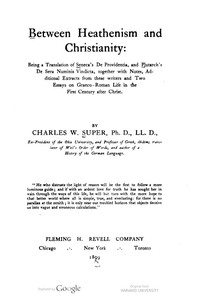
Before opening Between Heathenism and Christianity Being a translation of Seneca's De Providentia, and Plutarch's De sera numinis vindicta, together with notes, additional extracts — Key Ideas to Explore, the edition data offers a quick orientation: 60,079 words, 4 hr 22 min estimated reading time, and 13 detected text sections.
The text analysis averages about 26.3 words per sentence, while the detected sections provide another way to judge how the source is divided.
Project Gutenberg metadata also associates the work with “Stoics,” connecting these edition facts with the source record’s subject description.
Explore this collection
These alternatives are selected using recorded categories and estimated reading time.
About 246 minutes
Logic
56,578 recorded words. 16 minutes difference from this book's estimate.
View Gutenberg source #10684About 245 minutes
Logic
56,207 recorded words. 17 minutes difference from this book's estimate.
View Gutenberg source #7819About 240 minutes
Logic
55,004 recorded words. 22 minutes difference from this book's estimate.
View Gutenberg source #57998Search stored excerpts and compare books → Choose by your preferences →
Choices use stored catalog measurements. Estimates vary with reading speed. A shared category is a catalog label, not a claim that two books have the same argument or literary quality.
Search reads excerpt text stored with this catalog and links to its associated Gutenberg record. The connection is stored in the site database; this tool does not recheck that every excerpt is word-for-word identical to that external record. Excerpt search does not cover every chapter and does not verify historical publication dates.
Catalog snapshot checked: 2026-09-26. Coverage: 95 public books, 95 available source excerpts.
Calculated from edition completeness, EPUB availability, text structure and catalogue metadata. Not a user rating.
Total of 100 points, scaled to a 2.5-5.0 range. Editions with an empty description or a missing EPUB file are not scored.
Public-domain source text
The source text is kept in the dedicated reader, separate from this catalogue record and its commentary.
Seneca’s De Providentia and Plutarch’s De Sera Numinis Vindicta, translated here by Charles W. Super, confront a question that troubled the ancient mind: why do the good suffer while the wicked prosper? The two works approach the problem from different philosophical traditions—Seneca from Stoicism, Plutarch from a Platonic framework tinged with popular religion. Super’s editorial apparatus, including notes and two essays on Graeco-Roman life, frames these texts as evidence of the moral and religious ferment that preceded and accompanied early Christianity.
In De Providentia, Seneca argues that adversity is a divine tool for strengthening virtue. The wise person, he claims, is never truly harmed by misfortune, because external events cannot touch the inner self. Super’s translation captures Seneca’s rhetorical urgency: the text is less a systematic treatise than a consolatory address, urging the reader to see suffering as a form of divine training. The Stoic god is not a personal intervener but a rational principle that governs all things; thus, what appears evil is merely part of a larger, benevolent order. Seneca’s examples—drawn from Roman history and myth—reinforce his point that great men are tested by hardship. Yet the translation also reveals tensions: Seneca sometimes wavers between asserting providence and acknowledging the apparent randomness of fate, a contradiction Super notes in his introduction.
Plutarch’s De Sera Numinis Vindicta tackles the same problem but from a different angle: why divine punishment often seems slow or absent. Writing as a priest of Apollo at Delphi, Plutarch defends the gods’ justice by arguing that delay serves pedagogical and cosmic purposes. The treatise takes the form of a dialogue, a nod to Plato, though Plutarch’s interlocutors rarely challenge him at length. Super observes that Plutarch is “the bitter enemy of atheism” yet equally opposed to superstition, a balancing act that leads to occasional inconsistency. The translation shows Plutarch drawing on myths, historical anecdotes, and philosophical reasoning to argue that punishment, when it comes, is fitting and sometimes extends to descendants. His willingness to cite contradictory authorities and then declare a preference without full justification marks his method as more homiletic than rigorously philosophical.
Charles W. Super, a classicist and former president of Ohio University, provides two essays on Graeco-Roman life in the first century after Christ. These essays situate the translated works within the broader cultural and religious landscape of the early Roman Empire. Super emphasizes the “remarkable fact” of Christianity’s rapid spread, which he links to the moral vacuum left by traditional paganism. He notes that both Seneca and Plutarch, despite their differences, represent a turn toward inwardness and ethical rigor that prepared the ground for Christian thought. The essays also discuss the role of the family, the prevalence of superstition even among intellectuals, and the tension between faith and credulity. Super’s own voice is measured; he avoids dogmatic claims, instead presenting the ancient authors as witnesses to a world in transition.
Readers approaching this volume should attend to the contrasts between Seneca’s terse, imperative style and Plutarch’s more discursive, anecdotal manner. Super’s notes, though occasionally dated, clarify references and highlight points of disagreement between the two authors. The book is best read as a primary source for understanding how educated pagans grappled with the problem of evil—a problem that Christian thinkers would soon recast in new terms.
Reading Seneca’s calm about providence, I remembered elderberry smoke curling from our hedgerow, an old ritual of blessing. Then I recalled how Balder the Beautiful, Volume I. A Study in Magic and Religion: the Golden Bough, Part VII., The Fire-Festivals of Europe and the Doctrine of the External Soul — Story, Setting & Ideas once gave words to that familiar ache—how fire, too, becomes a prayer against what we cannot control.
Create a short personal record of your experience with this book.