
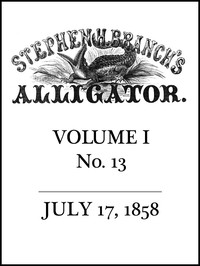
Stephen H. Branch's Alligator, Vol. 1 no. 13, July 17, 1858 by Stephen H. Branch
Let's be clear: this isn't a novel. It's a primary source, a single 12-page blast of fury from July 17, 1858. Stephen H. Branch published The Alligator himself, and in this issue, he has one target: Fernando Wood, the Mayor of New York City and a political powerhouse.
The Story
There's no plot in the usual sense. Instead, imagine a relentless, point-by-point legal and moral indictment. Branch lays out specific, detailed accusations against Wood. He claims Wood took bribes to fix court cases, orchestrated massive voter fraud by naturalizing immigrants just in time for elections, and used his police force as a personal gang to intimidate opponents. Branch writes like a prosecutor giving a closing argument, mixing formal charges with fiery, personal outrage. He's not just reporting the news; he's declaring war on what he sees as a corrupt empire running New York. The 'story' is the spectacle of this confrontation.
Why You Should Read It
First, the energy is incredible. You can feel Branch's desperation and conviction in every line. This isn't neutral reporting; it's activism. It shows how journalism functioned as a weapon long before Twitter. Second, it's shockingly familiar. Swap a few old-timey details, and the core complaints—corruption, abuse of power, rigged systems—could be headlines today. It pulls the rug out from under any idea of a 'gentlemanly' political past. Reading it connects you directly to the anger and frustration of an ordinary citizen (well, an extraordinarily angry one) in 1858. It's history without the polish.
Final Verdict
This is a niche but fascinating read. It's perfect for history buffs who want to get beyond textbooks and feel the grit of the past. If you're interested in the history of journalism, politics, or urban America, this is a goldmine. It's also great for anyone who enjoys a real-life David vs. Goliath story, even if David is shouting through a megaphone made of newsprint. Fair warning: it's a dense, specific rant, not a light narrative. But for a direct injection of pure, uncut 19th-century drama, you can't beat it.
This masterpiece is free from copyright limitations. You can copy, modify, and distribute it freely.
Patricia Moore
3 months agoI was particularly interested in the case studies mentioned here, the emphasis on ethics and sustainability within the topic is commendable. I'll be citing this in my upcoming project.
Mary Garcia
6 months agoIf you're tired of surface-level information, the way the author breaks down the core concepts is remarkably clear. This has become my go-to guide for this specific topic.
Richard Miller
5 months agoAs a professional in this niche, the author doesn't just scratch the surface but goes into meaningful detail. Well worth the time invested in reading it.
Charles Jones
8 months agoThe citations provided are a goldmine for further academic study.





Robert Gonzalez
2 years agoThe clarity of the concluding remarks is very professional.