
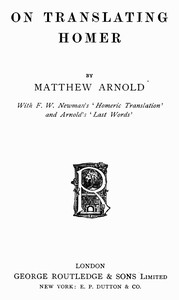
On Translating Homer by Matthew Arnold and Francis William Newman
Okay, let's set the scene. It's the mid-1800s. Francis William Newman, a scholar and thinker, publishes his translation of Homer's Iliad. He makes some bold choices. He uses a rough, ballad-like meter and language that tries to feel ancient and Anglo-Saxon, not polished and modern. His goal? To make Homer feel old and powerful to the everyday English reader, not just to university dons.
The Story
This book isn't a story in the usual sense. It's Newman's detailed explanation and defense of his whole translation philosophy. He lays out his reasoning chapter by chapter. Why use a certain meter? Why choose those specific, sometimes unusual, words? He argues that a translation must be faithful to the spirit and the historical feeling of the original, even if it sounds strange to contemporary ears. He’s essentially building his case before the court of public opinion, knowing that his approach is controversial.
Why You Should Read It
This might sound niche, but it’s fascinating. You get inside the head of a translator at work. It's a masterclass in the thousands of tiny decisions that go into taking words from one language and culture and planting them in another. Reading Newman's passionate defense makes you appreciate the art of translation so much more. It’s not just swapping words; it's a creative act with huge consequences. You also see the birth of a legendary literary feud. Knowing this is Newman's opening salvo against Matthew Arnold's later famous lectures adds a layer of drama. You're reading the first move in a high-stakes game of cultural criticism.
Final Verdict
This is a perfect pick for readers who love peeking behind the curtain of how books are made. If you've ever read a translation and wondered, "Why did they phrase it like that?" this book has your answers. It's also great for anyone interested in the history of ideas or classic Victorian debates. You don't need to be a Homer expert to enjoy it; you just need curiosity about language, art, and a really good intellectual argument. Think of it as the 19th-century blog post that started a firestorm.
The copyright for this book has expired, making it public property. Preserving history for future generations.
Richard Martin
1 year agoI've gone through the entire material twice now, and the insights into future trends are particularly thought-provoking. A mandatory read for anyone in this industry.
James Smith
7 months agoThis was exactly the kind of deep dive I was searching for, the historical context mentioned in the early chapters is quite enlightening. I'll be citing this in my upcoming project.
Joseph Taylor
9 months agoThis digital copy caught my eye due to its reputation, the way it handles controversial points with balance is quite professional. If you want to master this topic, start right here.
Ashley Taylor
2 years agoBefore I started my latest project, I read this and the inclusion of diverse viewpoints strengthens the overall narrative. This has become my go-to guide for this specific topic.

Jessica Martin
1 year agoThe information is current and very relevant to today's needs.