About 27 minutes
Which Shall Live—Men or Animals? — Story, Setting & Ideas
Ethics
6,176 recorded words. 1 minutes difference from this book's estimate.
View Gutenberg source #65970
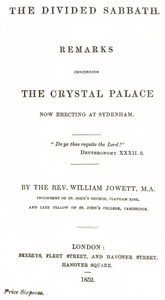
Before opening The Divided Sabbath remarks concerning the Crystal Palace now erecting at Sydenham — Reading Notes, the edition data offers a quick orientation: 5,900 words, 26 min estimated reading time, and 1 detected text section.
The text analysis averages about 23.2 words per sentence, while the detected sections provide another way to judge how the source is divided.
Project Gutenberg metadata also associates the work with “Crystal Palace (Sydenham, London, England),” connecting these edition facts with the source record’s subject description.
Explore this collection
These alternatives are selected using recorded categories and estimated reading time.
About 27 minutes
Ethics
6,176 recorded words. 1 minutes difference from this book's estimate.
View Gutenberg source #65970About 35 minutes
Ethics
7,982 recorded words. 9 minutes difference from this book's estimate.
View Gutenberg source #31768About 39 minutes
Ethics
8,852 recorded words. 13 minutes difference from this book's estimate.
View Gutenberg source #36695Search stored excerpts and compare books → Choose by your preferences →
Choices use stored catalog measurements. Estimates vary with reading speed. A shared category is a catalog label, not a claim that two books have the same argument or literary quality.
Search reads excerpt text stored with this catalog and links to its associated Gutenberg record. The connection is stored in the site database; this tool does not recheck that every excerpt is word-for-word identical to that external record. Excerpt search does not cover every chapter and does not verify historical publication dates.
Catalog snapshot checked: 2026-09-26. Coverage: 95 public books, 95 available source excerpts.
Calculated from edition completeness, EPUB availability, text structure and catalogue metadata. Not a user rating.
Total of 100 points, scaled to a 2.5-5.0 range. Editions with an empty description or a missing EPUB file are not scored.
Public-domain source text
The source text is kept in the dedicated reader, separate from this catalogue record and its commentary.
William Jowett’s 1852 pamphlet responds directly to a Times report of August 2nd, which stated that the Crystal Palace Company had secured a government charter to open the Sydenham grounds on Sundays after 1 p.m. Jowett, an Anglican incumbent, writes as an “Englishman” and “Clergyman” to oppose what he calls the “Divided Sabbath.” He does not object to the Palace’s grandeur, exotic plants, or manufactures, but singles out the sculpture department as objectionable and focuses his argument on the moral danger of Sunday opening. The pamphlet is structured as a public appeal, citing Deuteronomy 32:6 and addressing the Queen and country directly.
The pamphlet opens by reprinting a Times article from August 2, 1852, which Jowett describes as “on one side at least, demi-official.” The report details the Company’s proposed Sunday schedule: trains would not run before 1 p.m., the building itself would remain closed until then, and afterward only the Park and Winter-Garden would open, with no alcohol sold. Lord Derby, the Prime Minister, had acquiesced with “a few trifling variations.” Jowett treats this report as the occasion for his remarks, but he does not verify its accuracy; instead, he uses it to frame the issue as a national crisis. He later references a second Times article from August 6 describing the ceremonial erection of the first column, grounding his argument in contemporary events.
Jowett’s core argument hinges on a distinction between true Sabbath rest and mere recreation. He warns that the proposed Sunday opening would “rob the Poor of their real Rest” by substituting “imaginary recreation” that cannot be enjoyed “without sin.” The pamphlet does not elaborate on what constitutes proper Sunday observance, but it repeatedly frames the issue as a choice between God’s law and worldly amusement. Jowett appeals to “The Million” as “Englishmen” and “Bible-men” to reject the offer. He does not cite specific biblical passages beyond the epigraph, but his rhetoric implies a covenantal understanding of national duty: the Crystal Palace plan threatens to build “a People’s happiness on the basis of God’s broken law.”
Jowett’s closing paragraphs shift from argument to direct appeal and prophecy. He expresses hope that the “rumour of such a Charter may die away to nothing” and calls for national awakening from “dreams of amusement.” He invokes the biblical figure of Darius, who refused to sign a decree, as a model for the Queen. The pamphlet ends with a conditional warning: if the charter is granted, the poor will be robbed of rest; if not, deliverance may come from a “very humble quarter.” Jowett does not claim to know the outcome, but he frames the moment as a “crisis of great danger” for Britain. The tone is urgent, personal, and pastoral, reflecting his dual role as clergyman and citizen.
Readers should note that Jowett’s pamphlet is a response to a specific news report, not a comprehensive treatise on Sabbath theology. The excerpts do not reveal whether the charter was ultimately granted or how the public reacted. Jowett’s language is deliberately alarmist, and his arguments rely on a shared understanding of biblical authority that may not be familiar to modern readers. The pamphlet offers a focused case study in mid-Victorian religious controversy, where national identity, class, and leisure intersect.
I kept thinking about that old pamphlet's quiet worry—how rest can slip away when we split sacred time into pieces. It reminded me of something deeper in Feuerbach — A Reader’s Guide, where our longing for wholeness gets projected onto things we barely understand. Funny how a Victorian argument still whispers today. I closed both books slowly, feeling the weight of what never quite leaves us.
Use these questions to collect your thoughts before moving on.









