About 26 minutes
The Divided Sabbath remarks concerning the Crystal Palace now erecting at Sydenham — Reading Notes
Ethics
5,900 recorded words. 1 minutes difference from this book's estimate.
View Gutenberg source #62203
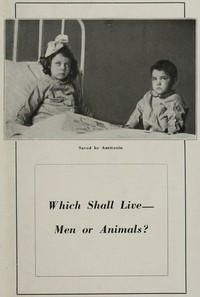
For Which Shall Live—Men or Animals? — Story, Setting & Ideas, the stored edition analysis reports 6,176 words, 27 min estimated reading time, and 4 detected text sections.
The text analysis averages about 25.1 words per sentence, while the detected sections provide another way to judge how the source is divided.
Project Gutenberg metadata also associates the work with “Vivisection,” connecting these edition facts with the source record’s subject description.
Explore this collection
These alternatives are selected using recorded categories and estimated reading time.
About 26 minutes
Ethics
5,900 recorded words. 1 minutes difference from this book's estimate.
View Gutenberg source #62203About 35 minutes
Ethics
7,982 recorded words. 8 minutes difference from this book's estimate.
View Gutenberg source #31768About 39 minutes
Ethics
8,852 recorded words. 12 minutes difference from this book's estimate.
View Gutenberg source #36695Search stored excerpts and compare books → Choose by your preferences →
Choices use stored catalog measurements. Estimates vary with reading speed. A shared category is a catalog label, not a claim that two books have the same argument or literary quality.
Search reads excerpt text stored with this catalog and links to its associated Gutenberg record. The connection is stored in the site database; this tool does not recheck that every excerpt is word-for-word identical to that external record. Excerpt search does not cover every chapter and does not verify historical publication dates.
Catalog snapshot checked: 2026-09-26. Coverage: 95 public books, 95 available source excerpts.
Calculated from edition completeness, EPUB availability, text structure and catalogue metadata. Not a user rating.
Total of 100 points, scaled to a 2.5-5.0 range. Editions with an empty description or a missing EPUB file are not scored.
Public-domain source text
The source text is kept in the dedicated reader, separate from this catalogue record and its commentary.
Ernest Harold Baynes opens his 1923 argument by comparing disease to a foreign invasion: if a few thousand citizens faced death from an enemy army, the nation would mobilize millions of men and billions of dollars, yet diseases that kill far more provoke scarcely an extra heartbeat. This rhetorical strategy frames vivisection as a patriotic and urgent defense. Baynes, writing for the American Medical Association's Hygeia, draws on historical plague accounts—quoting Defoe's description of victims in torment—and recent Indian mortality figures to argue that animal experimentation is essential for public health.
Baynes's central analogy equates disease with a military threat, but the comparison is deliberately asymmetrical. He notes that bubonic plague killed over a million in India in 1905, yet Americans sleep peacefully because a “small garrison of vigilant medical men” watches the coasts. The language of combat—enemy, combat, garrison—transforms laboratory research into a defensive action. Notably, the enemy is not a foreign power but a microscopic one, and the soldiers are scientists using animals as proxies. This framing allows Baynes to present vivisection as a necessary sacrifice for national security, shifting the moral weight from the suffering of individual animals to the protection of human populations.
Baynes grounds his argument in specific historical and scientific details. He cites the 1894 discovery of Bacillus pestis bubonicae and explains that experiments on rats, guinea-pigs, and monkeys revealed how the disease spreads. Without naming a single researcher, he implies that these animal tests were the key to controlling plague. The excerpt also references Defoe's History of the Plague to evoke the horrors of uncontrolled epidemic: people “raving and distracted,” mothers murdering their children. By juxtaposing past suffering with modern control, Baynes suggests that animal experimentation is the only barrier between civilization and chaos.
The text concludes with a resolution passed unanimously by the American Society of Mammalogists in May 1923, after Baynes presented his paper. The resolution states that animal experimentation is conducted “humanely and with a minimum of discomfort” and that interference would harm “real humanity.” This institutional backing serves as a rhetorical capstone, transforming Baynes's personal plea into a collective professional stance. The resolution's language—calling antivivisectionists “misinformed and misguided”—mirrors Baynes's own dismissive tone toward opponents, whom he labels “dangerous fanatics” whose teachings could cause epidemics killing thousands of children.
Baynes's pamphlet is a tightly focused artifact of a specific historical moment, when the medical establishment sought to consolidate public support for vivisection. Readers should note that the text does not engage with animal welfare arguments on their own terms; instead, it frames the debate as a zero-sum choice between human lives and animal suffering. The excerpts leave unclear whether Baynes addresses any counterevidence or alternative methods, but the rhetorical structure—invasion, historical precedent, institutional resolution—is designed to preempt dissent.
Somewhere between those plague statistics and the call to weigh animal lives, I found myself thinking of Eucken’s quiet insistence that meaning outlasts argument. That old pamphlet feels less like a verdict than a question left open—almost tender in its urgency. It pairs strangely well with the gentler philosophy I keep nearby: Rudolph Eucken : a philosophy of life — Context and Discussion. Two voices, a century apart, both wrestling with what we owe each other.
Create a short personal record of your experience with this book.









