
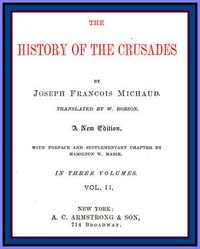
The History of the Crusades (vol. 2 of 3) by J. Fr. Michaud
Picking up after the bloody but successful First Crusade, Michaud's second volume asks a simple, haunting question: Now what? The Christian kingdoms of Outremer are established, but they're isolated, surrounded, and running on borrowed time. This isn't the story of a glorious conquest; it's the grueling, century-long struggle to keep it.
The Story
The book marches through the 12th century, a period defined by fragile truces and sudden, devastating wars. We watch the Crusader states, like the Kingdom of Jerusalem, slowly bleed out. New crusades from Europe arrive with great fanfare, only to get bogged down in politics or suffer military disaster. The narrative builds toward its pivotal moment: the rise of Saladin and his decisive victory at the Battle of Hattin in 1187, which leads to the recapture of Jerusalem for Islam. Michaud follows the aftermath—the shockwaves through Europe, the launch of the famous Third Crusade led by Richard the Lionheart, and the eventual, uneasy stalemate that leaves the Crusader presence a shadow of its former self.
Why You Should Read It
What makes this old history feel so immediate is Michaud's focus on human folly and fragile power. He doesn't paint the Crusaders as pure heroes or villains, but as flawed people in an impossible situation. You see their internal squabbles, their arrogance, and their moments of genuine bravery. Saladin is portrayed with a surprising depth and respect, which was less common for European historians of Michaud's time. The real theme here is the collision of idealism and realpolitik. The grand dream of holding Jerusalem keeps crashing against the realities of supply lines, local diplomacy, and simple human exhaustion. It’s a sobering lesson in how hard it is to maintain a war fought for an idea, thousands of miles from home.
Final Verdict
This is perfect for anyone who loves deep-dive historical narratives that feel like political thrillers. It’s not a light read—it’s dense with names and events—but the drama is inherent in the material. You don't need to be a scholar to get swept up in the tragedy of it all. If you enjoyed the first volume, this is an essential, if heavier, continuation. If you're new to the series and are fascinated by this chaotic period, start with Volume 1, but know that this middle chapter is where the true weight of history is felt. A compelling, often grim account of an empire built on sand.
This masterpiece is free from copyright limitations. Distribute this work to help spread literacy.
Ashley Garcia
3 months agoRight from the opening paragraph, the way the author breaks down the core concepts is remarkably clear. Finally, a source that prioritizes accuracy over hype.
Emily Johnson
6 months agoAs a professional in this niche, the insights into future trends are particularly thought-provoking. This has become my go-to guide for this specific topic.
Jennifer Taylor
1 year agoA sophisticated analysis that fills a gap in the literature.
Robert Thompson
1 year agoThis is now a staple reference in my professional collection.








James Lee
8 months agoGiven the current trends in this field, the author doesn't just scratch the surface but goes into meaningful detail. Truly a masterpiece of digital educational material.