About 500 minutes
De Officiis — Inside the Classic
Political Philosophy
114,828 recorded words. 92 minutes difference from this book's estimate.
View Gutenberg source #47001
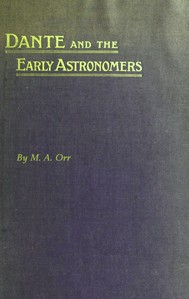
Before opening Dante and the early astronomers — Inside the Classic, the edition data offers a quick orientation: 135,992 words, 9 hr 52 min estimated reading time, and 62 detected text sections.
The text analysis averages about 24.9 words per sentence, while the detected sections provide another way to judge how the source is divided.
Project Gutenberg metadata also associates the work with “Astronomy, Ancient,” connecting these edition facts with the source record’s subject description.
Explore this collection
These alternatives are selected using recorded categories and estimated reading time.
About 500 minutes
Political Philosophy
114,828 recorded words. 92 minutes difference from this book's estimate.
View Gutenberg source #47001About 474 minutes
Political Philosophy
108,925 recorded words. 118 minutes difference from this book's estimate.
View Gutenberg source #57980About 740 minutes
Political Philosophy
170,048 recorded words. 148 minutes difference from this book's estimate.
View Gutenberg source #38117Search stored excerpts and compare books → Choose by your preferences →
Choices use stored catalog measurements. Estimates vary with reading speed. A shared category is a catalog label, not a claim that two books have the same argument or literary quality.
Search reads excerpt text stored with this catalog and links to its associated Gutenberg record. The connection is stored in the site database; this tool does not recheck that every excerpt is word-for-word identical to that external record. Excerpt search does not cover every chapter and does not verify historical publication dates.
Catalog snapshot checked: 2026-09-26. Coverage: 95 public books, 95 available source excerpts.
Calculated from edition completeness, EPUB availability, text structure and catalogue metadata. Not a user rating.
Total of 100 points, scaled to a 2.5-5.0 range. Editions with an empty description or a missing EPUB file are not scored.
Public-domain source text
The source text is kept in the dedicated reader, separate from this catalogue record and its commentary.
M. A. Orr, writing from the Kodaikanal Observatory in South India, brings an astronomer's precision to Dante's celestial imagery. Her preface notes the challenge of writing on astronomy and poetry from a mountain top, where access to specialized books was limited. The work draws on authorities such as Alfraganus, Aristotle, and Aratus, and is dedicated to Lucy. Orr's analysis focuses on how Dante used constellations like Ursa Major and Minor, and the fifteen first-magnitude stars, to construct the heavenly realms of the Paradiso.
Orr traces Dante's references to the Bears (Ursa Major and Minor) across the Commedia. In Paradiso ii. 9, Minerva blows a favoring wind, Apollo steers, and the nine Muses guide by the Bears. Purgatorio iv. 65 uses them to indicate the northern sky. Orr notes that Dante also draws on Ovid's fable of Helice, transformed into a she-bear and hunted by her son, to explain the constellation's origin. She observes that the Barbarians who marvel at Rome in Paradiso xxxi likely come from regions where Ursa Major never sets, possibly Scotland or Scandinavia, though she cautions against overinterpreting the Arctic Circle reference.
In Paradiso xiii, Dante creates a simile of two new constellations from the brightest stars: fifteen first-magnitude stars, the Wain (Ursa Major), and the mouth of the horn (Ursa Minor) whose tip is the Pole Star. Orr identifies these as the stars listed by Alfraganus as second magnitude. She explains that Dante groups them into two crowns resembling Corona Borealis, Ariadne's Crown. The star-like spirits sing and circle in a dance whose swiftness is compared to the Primum Mobile versus the sluggish Chiana river. Orr notes that the spirits' brightness expresses their happiness, increasing in each heaven.
Orr's list of principal authorities includes Alfraganus's Elementa Astronomica, Aristotle's Four Books on the Heavens, and Aratus's Phainomena. She also cites modern works like Berry's History of Astronomy and Boffito's Almanach Dantis Aligherii. Her method is to compare Dante's astronomical passages with these sources, identifying where Dante follows or adapts ancient knowledge. For instance, she notes that Dante uses the word segni for any constellation, a usage found in Ristoro, while modern usage restricts signs to zodiac divisions. This attention to terminology reveals Dante's medieval astronomical framework.
Orr's study is best read alongside a text of the Divine Comedy and a star chart. Her observations are grounded in the poem's wording and the astronomical sources Dante likely used. Readers interested in the intersection of poetry and science will find a meticulous, evidence-based account that illuminates how Dante constructed his cosmic vision without straying into speculation about the poem's allegorical meaning.
There are evenings when Dante’s ordered spheres feel like a comfort, a map for the homesick soul. Reading Orr’s patient tracing of his stars, I’m reminded of quieter certainties, the kind found in The Following of Christ, in Four Books Translated from the Original Latin of Thomas a Kempis — Context and Discussion. Both books ask us to look inward, yet upward, and I miss that stillness.
Capture what you thought, learned, and would like to remember.