About 500 minutes
De Officiis — Inside the Classic
Political Philosophy
114,828 recorded words. 26 minutes difference from this book's estimate.
View Gutenberg source #47001
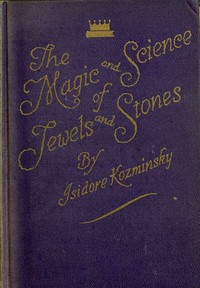
Before opening The Magic and Science of Jewels and Stones — Inside the Classic, the edition data offers a quick orientation: 108,925 words, 7 hr 54 min estimated reading time, and 41 detected text sections.
The text analysis averages about 22.1 words per sentence, while the detected sections provide another way to judge how the source is divided.
Project Gutenberg metadata also associates the work with “Gems -- Miscellanea,” connecting these edition facts with the source record’s subject description.
Explore this collection
These alternatives are selected using recorded categories and estimated reading time.
About 500 minutes
Political Philosophy
114,828 recorded words. 26 minutes difference from this book's estimate.
View Gutenberg source #47001About 592 minutes
Political Philosophy
135,992 recorded words. 118 minutes difference from this book's estimate.
View Gutenberg source #64489About 289 minutes
Political Philosophy
66,362 recorded words. 185 minutes difference from this book's estimate.
View Gutenberg source #60377Search stored excerpts and compare books → Choose by your preferences →
Choices use stored catalog measurements. Estimates vary with reading speed. A shared category is a catalog label, not a claim that two books have the same argument or literary quality.
Search reads excerpt text stored with this catalog and links to its associated Gutenberg record. The connection is stored in the site database; this tool does not recheck that every excerpt is word-for-word identical to that external record. Excerpt search does not cover every chapter and does not verify historical publication dates.
Catalog snapshot checked: 2026-09-26. Coverage: 95 public books, 95 available source excerpts.
Calculated from edition completeness, EPUB availability, text structure and catalogue metadata. Not a user rating.
Total of 100 points, scaled to a 2.5-5.0 range. Editions with an empty description or a missing EPUB file are not scored.
Public-domain source text
The source text is kept in the dedicated reader, separate from this catalogue record and its commentary.
Isidore Kozminsky opens his 1922 study with a stated aim: to blend modern science with the ancient and occult philosophy of stones. He argues that many seemingly absurd old narratives are actually cunningly concealed truths, and that the ancient masters held that heavenly bodies entered into harmonious relations with terrestrial substances. This yields a philosophy of fortunate stones, planetary gems, and talismanic magic, governed by sympathy and antipathy throughout nature.
The excerpts show a work that moves between cataloging famous diamonds—such as the Star of Africa, cut from the Cullinan, and the Mattam, held responsible for worldly trouble—and expounding on the spiritual and magical properties of gems. Kozminsky's voice is earnest and encyclopedic, blending precise carat weights and prices with claims about the influences of stones.
Kozminsky's preface declares a sincere attempt to blend modern science with ancient occult philosophy. He asserts that the ancient masters held that heavenly bodies influenced terrestrial substances, leading to a system of fortunate stones and talismanic magic. This system is based on sympathy and antipathy—atom for atom, stone for stone—which he claims was subjected to an orderly scientific arrangement comparable to modern synthesis. The excerpts do not reveal how deeply he integrates these two approaches, but the tension between empirical gemology and esoteric tradition is central.
For instance, he provides detailed weights and cutting histories for diamonds like the Jubilee (634 carats rough) and the Star of South Africa (83½ carats rough), yet also notes that the Mattam diamond is held responsible for much worldly trouble. This juxtaposition of factual data with supernatural attribution is a recurring pattern.
Kozminsky repeatedly anchors his descriptions in historical and monetary specifics. The Star of Africa was purchased by the Transvaal Government for £150,000 and presented to King Edward VII; the Nizam of Hyderabad bought the Imperial diamond for £20,000 in 1884. The Mattam diamond, found in 1760 (or 1787, per Dr. Smith), prompted a Dutch governor to offer two gun-boats and £50,000, an offer refused because the Rajah believed his family's fortunes depended on it.
These details ground the stones in human transactions and conflicts. Kozminsky notes that the Star of Africa has no record of evil, no doubtful past, nor is it tainted with evil desires, violence or sorrow—implying that other stones carry such burdens. The contrast between the clean regalia diamond and the troubled Mattam is a clear example of the moral weight he assigns to gems.
Kozminsky includes voices of skepticism. He notes that the genuineness of the Mattam diamond is doubted by Dr. Smith, and that the Braganza stone is believed on good grounds to be a large white topaz rather than a diamond. These asides introduce a scientific caution that tempers the occult claims. The author does not simply accept all lore; he presents conflicting views.
Similarly, the description of the Star of the South notes that although not perfectly white, it is regarded as one of the finest large diamonds of the day. This attention to imperfection and debate suggests a work that acknowledges uncertainty. The excerpts do not reveal how Kozminsky resolves these tensions, but the pattern of presenting both magical attributions and scientific doubts is evident.
Readers will find a work that oscillates between the measurable and the mystical. Kozminsky's catalog of famous stones—with their carat weights, prices, and histories—sits alongside claims about planetary influences and talismanic power. The excerpts offer a glimpse of a system that seeks to harmonize these realms, but the full synthesis remains to be explored. Approach the text as a document of its time, where gemology and occultism were not yet fully separated.
You know that feeling when a book stays with you, like a stone you keep turning in your pocket? Kozminsky’s old gemology book felt that way—quiet, strange, alive. It reminded me of another lingering read, a collection of sketches about John Stuart Mill’s life and work. Not flashy, just thoughtful. John Stuart Mill; His Life and Works Twelve Sketches by Herbert Spencer, Henry Fawcett, Frederic Harrison, and Other Distinguished Authors — Reading Companion rests beside it in memory, a different kind of weight.
Use these questions to collect your thoughts before moving on.