About 173 minutes
Three Dialogues Between Hylas and Philonous in Opposition to Sceptics and Atheists — Reading Notes
Political Philosophy
39,709 recorded words. 9 minutes difference from this book's estimate.
View Gutenberg source #4724
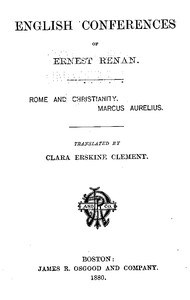
This digital edition of English Conferences of Ernest Renan: Rome and Christianity. Marcus Aurelius — Themes and Context is described by source-level measurements including 37,621 words, 2 hr 44 min estimated reading time, and 4 detected text sections.
The text analysis averages about 21.9 words per sentence, while the detected sections provide another way to judge how the source is divided.
Project Gutenberg metadata also associates the work with “Marcus Aurelius, Emperor of Rome, 121-180,” connecting these edition facts with the source record’s subject description.
Explore this collection
These alternatives are selected using recorded categories and estimated reading time.
About 173 minutes
Political Philosophy
39,709 recorded words. 9 minutes difference from this book's estimate.
View Gutenberg source #4724About 176 minutes
Political Philosophy
40,315 recorded words. 12 minutes difference from this book's estimate.
View Gutenberg source #4723About 144 minutes
Political Philosophy
33,106 recorded words. 20 minutes difference from this book's estimate.
View Gutenberg source #4094Search stored excerpts and compare books → Choose by your preferences →
Choices use stored catalog measurements. Estimates vary with reading speed. A shared category is a catalog label, not a claim that two books have the same argument or literary quality.
Search reads excerpt text stored with this catalog and links to its associated Gutenberg record. The connection is stored in the site database; this tool does not recheck that every excerpt is word-for-word identical to that external record. Excerpt search does not cover every chapter and does not verify historical publication dates.
Catalog snapshot checked: 2026-09-26. Coverage: 95 public books, 95 available source excerpts.
Calculated from edition completeness, EPUB availability, text structure and catalogue metadata. Not a user rating.
Total of 100 points, scaled to a 2.5-5.0 range. Editions with an empty description or a missing EPUB file are not scored.
Public-domain source text
The source text is kept in the dedicated reader, separate from this catalogue record and its commentary.
Ernest Renan’s 1880 London lectures, translated by Clara Erskine Clement, advance a provocative thesis: Christianity, far from being purely a Jewish or Hellenistic phenomenon, was in a decisive sense a Roman work. Renan, a historian of religion and former seminarian, argues that the Roman Empire provided the institutional skeleton, legal habits, and universalist ambition that allowed a small Jewish sect to become the Catholic Church. The volume contains four Hibbert lectures on “Rome and Christianity” and a separate Royal Institution lecture on Marcus Aurelius. Renan’s method is comparative and critical, treating religious development as a historical process subject to the same analysis as political or social change. He draws parallels between early Christian legend-making and modern political mythmaking, as when he compares the pairing of Peter and Paul to the pairing of Victor Emmanuel and Pius IX in nineteenth-century Italy.
Renan’s first lecture establishes his central claim: “Christianity is a Roman work” not because Romans invented its theology, but because Rome supplied the conditions for its universal expansion. He points to the Roman road system, the common language of Greek and Latin, and the legal concept of a universal empire as prerequisites for a universal church. The Roman genius for organization, administration, and law gave Christianity a model for ecclesiastical hierarchy. Renan notes that the very term “Catholic” implies a universality that mirrors Roman imperial ideology. He argues that without Rome, Christianity might have remained a collection of scattered Jewish and Gentile communities, never coalescing into a single authoritative body.
In the second lecture, Renan examines how the early church constructed a harmonized tradition around the apostles Peter and Paul. He observes that historical evidence suggests sharp conflict between Paul’s Gentile mission and the Jewish-Christian faction associated with Peter. Yet by the late first century, Christian writers began to depict the two apostles as co-founders of the Roman church, united in doctrine and martyrdom. Renan calls this process an “instinctive travail” that reshaped history to match communal desire. He draws a striking analogy to modern Italy, where portraits of Victor Emmanuel and Pius IX were hung side by side, creating a retrospective legend of harmony. The legend of Peter and Paul, Renan argues, served to legitimize Roman ecclesiastical authority by grounding it in a dual apostolic foundation.
The third lecture traces how Rome became the center of ecclesiastical authority. Renan emphasizes the practical advantages of the Roman church: its location in the imperial capital, its relative wealth, and its reputation for orthodoxy. He notes that the Roman church’s claim to apostolic foundation by both Peter and Paul gave it a unique prestige. Renan describes a process of “concessions” in which Paul’s followers gradually absorbed Peter’s, while the Jewish-Christian Ebionite communities grew poorer and more isolated. The money of the Pauline churches, he writes, supported “glorious poor men” who preserved the primitive spirit. Over time, the distinction between parties faded, and a unified Catholic Church emerged, with Rome as its undisputed head. Renan’s analysis is materialist in its attention to resources and organization, not just ideas.
Readers approaching this volume should note that Renan writes as a critical historian, not a believer. His lectures were delivered to a liberal Protestant audience in London and reflect the intellectual currents of the 1880s: comparative religion, historical criticism, and a confidence in scientific method. The lecture on Marcus Aurelius, though shorter, offers a counterpoint: the Stoic emperor represents the best of pagan virtue, yet his reign saw the consolidation of the church he opposed. Renan’s style is elegant and occasionally ironic, and his analogies—such as the Victor Emmanuel–Pius IX parallel—reveal his willingness to apply critical methods to contemporary as well as ancient history.
A brief reflection can help important ideas stay with you longer.