About 592 minutes
Dante and the early astronomers — Inside the Classic
Political Philosophy
135,992 recorded words. 148 minutes difference from this book's estimate.
View Gutenberg source #64489
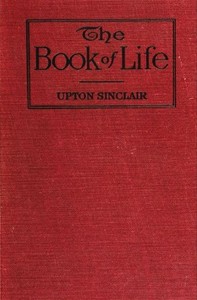
The source record for The Book of Life — Story, Setting & Ideas measures this digital text at 170,048 words, 12 hr 20 min estimated reading time, and 19 detected text sections.
The text analysis averages about 28.3 words per sentence, while the detected sections provide another way to judge how the source is divided.
Project Gutenberg metadata also associates the work with “Hygiene,” connecting these edition facts with the source record’s subject description.
Explore this collection
These alternatives are selected using recorded categories and estimated reading time.
About 592 minutes
Political Philosophy
135,992 recorded words. 148 minutes difference from this book's estimate.
View Gutenberg source #64489About 500 minutes
Political Philosophy
114,828 recorded words. 240 minutes difference from this book's estimate.
View Gutenberg source #47001About 474 minutes
Political Philosophy
108,925 recorded words. 266 minutes difference from this book's estimate.
View Gutenberg source #57980Search stored excerpts and compare books → Choose by your preferences →
Choices use stored catalog measurements. Estimates vary with reading speed. A shared category is a catalog label, not a claim that two books have the same argument or literary quality.
Search reads excerpt text stored with this catalog and links to its associated Gutenberg record. The connection is stored in the site database; this tool does not recheck that every excerpt is word-for-word identical to that external record. Excerpt search does not cover every chapter and does not verify historical publication dates.
Catalog snapshot checked: 2026-09-26. Coverage: 95 public books, 95 available source excerpts.
Calculated from edition completeness, EPUB availability, text structure and catalogue metadata. Not a user rating.
Total of 100 points, scaled to a 2.5-5.0 range. Editions with an empty description or a missing EPUB file are not scored.
Public-domain source text
The source text is kept in the dedicated reader, separate from this catalogue record and its commentary.
Upton Sinclair opens The Book of Life by framing it as a friendly offering of hard-won knowledge. At forty-two, he claims to have made many painful mistakes and now seeks to spare others the same suffering. The book, he writes, is modern, wise, honest, and kind—claims he supports by noting that he watches new achievements of the human mind and adjusts his thoughts accordingly. He does not pretend to know what he only guesses, and he promises to say so frankly when guessing is necessary.
The work is structured in two volumes: Mind and Body, and Love and Society. Sinclair's tone is direct and personal, addressing the reader as someone earnest, hungry for happiness, and groping in a fog. He argues that schools, newspapers, and churches fail to provide the everyday information needed for successful living, and that no existing book attempts to fill that gap.
Sinclair explicitly distances his book from academic or institutional sources. He notes that schools are not entirely competent, newspapers not entirely honest, and churches not entirely up to date. Instead, he offers his own experience as a guide, having received thousands of letters from readers asking about cancer cures, marital unhappiness, investments, and self-education. This framing positions the book as a direct response to real, everyday problems rather than a theoretical treatise.
The author's voice is conversational and confessional. He admits to having made mistakes and learned from them, and he presents his knowledge as something acquired through pain. This personal stake gives the book an urgency that a more detached manual would lack. Yet Sinclair also insists on intellectual honesty: he will not pretend to know what he only guesses, and he will say so frankly. This tension between personal authority and epistemic humility runs throughout the excerpts.
Sinclair's discussion of sex equality draws heavily on evolutionary biology and anthropology. He describes nature as perfectly ruthless, willing to destroy individuals of either sex to accomplish her purpose. He cites examples such as the female spider devouring her mate and the male bee falling disemboweled after mating. These vivid, almost shocking images serve to illustrate that nature offers no moral lessons—only the drive to preserve and propagate.
From this foundation, Sinclair argues that human society has developed through gregarious instincts and group cooperation, which allowed early humans to survive. He then traces the evolution of sex taboos and the system of the gens, where all men of one clan married all women of another. He notes that in primitive communist societies, women were generally equal to men, doing drudgery but also respected and assertive. He supports this with an anecdote from Frederick O'Brien's White Shadows in the South Seas, in which a cannibal lady physically carries off a male traveler. The anecdote is comic but also pointed: it challenges assumptions about female passivity.
Sinclair is careful to qualify his claims. When discussing primitive communism and sex relationships, he writes that anthropologists are still arguing over the exact meaning of the data, and he will not attempt to decide among them. He rests content with the statement that communism and tribal ownership are widespread enough to suggest an early stage in social evolution. This restraint is consistent with his earlier promise to be honest about what he only guesses.
However, the excerpts also reveal gaps. Sinclair does not specify which anthropologists he relies on, nor does he address counterarguments. His use of a single travel narrative as evidence for female dominance is anecdotal. Readers should note that the book was published in 1921–1922, and the scientific and anthropological sources Sinclair draws on may be dated or contested. The work is best read as a document of its time, reflecting early 20th-century progressive thought and its engagement with evolutionary theory.
Sinclair's The Book of Life is not a systematic treatise but a personal, opinionated guide. Readers will find its value in the author's willingness to tackle taboo subjects and his insistence on intellectual honesty, rather than in its scientific rigor. The book rewards those who approach it as a conversation with a passionate, self-aware thinker, one who admits his own fallibility while urging others to learn from his experience. For the modern reader, it offers a window into the progressive mindset of the early 1920s, with its blend of optimism, evolutionary thinking, and social critique.
There’s something humbling about a book that admits its own limits while still reaching for the stars, isn’t there? Sinclair’s honest grasp at living well left that ache with me—the same quiet wonder I felt reading Dante and the early astronomers — Inside the Classic, where old maps of the heavens feel more like a friend’s steady hand than a science lesson. It just lingered.
Capture what you thought, learned, and would like to remember.